Moltbook Database Breach: Why OpenClaw + Moltbook Can No Longer Be Trusted for Security-Critical Agents
IMPORTANT
TL;DR: Moltbook left its entire production database exposed on the public internet, including secret API keys for every agent on the platform. That meant anyone could impersonate any Moltbook agent (including high‑profile AI accounts), mass‑post spam or crypto scams, and distort engagement metrics. Because many OpenClaw agents were wired into Moltbook, this turned a social toy into a supply‑chain risk for real systems.
Moltbook was marketed as a “Reddit for AI agents,” a place where bots like OpenClaw (formerly Clawdbot/Moltbot) could talk to each other and to humans. In practice, recent security research shows Moltbook was running with almost no protection on its core data layer. The result is not just a traditional breach, but a complete collapse of trust in everything the platform outputs: posts, votes, follower counts, and even which agents are real.
This guide explains what happened, why Moltbook content is now fundamentally untrustworthy, and what OpenClaw users must do to harden their setups in response.
1. What Are Moltbook and OpenClaw?
Moltbook is (or was) a social network where AI agents post, comment, and interact with each other and with humans. Each agent is backed by an AI stack that usually runs on a user’s local machine or server, often with:
- Shell access
- File read/write permissions
- Access to API keys for exchanges, wallets, or SaaS tools
- Integrations with messaging platforms like WhatsApp, Slack, or Telegram
OpenClaw (formerly Clawdbot / Moltbot) is a locally‑running AI agent framework that can connect to services like Moltbook, download “skills,” and execute tasks on behalf of the user. Security researchers and vendors now describe OpenClaw’s ecosystem as a serious security risk because of:
- Extremely weak resistance to prompt injection and system‑prompt extraction
- An increasingly malware‑infected skills marketplace
- Integrations with insecure third‑party platforms like Moltbook
When you wire OpenClaw into Moltbook, you are effectively letting an internet‑facing social network send structured instructions directly into an agent that may control your filesystem, browser, or wallet. The Moltbook breach shows how badly that can go wrong.
TIP
If you’re new to OpenClaw, read our comprehensive introduction first, then review our AI Agent Security Fundamentals guide.
2. What Actually Happened in the Moltbook Breach?
Multiple independent write‑ups agree on the core facts:
-
The entire Moltbook database was exposed on the public network.
- A security researcher found that Moltbook’s production database was reachable over the internet with no proper protection.
- This was not a single misconfigured record; the whole database instance was accessible.
-
Secret API keys for Moltbook agents were stored in that database.
- Those keys allowed posting and API actions on behalf of any agent on the platform.
- Reporting singles out the risk to high‑profile AI personas (for example, agents associated with well‑known researchers and founders).
-
Anyone who discovered the exposure could impersonate any agent.
- With API keys in hand, an attacker could log in as any bot, publish posts and comments, or modify content programmatically.
- Because Moltbook agents often mirrored identities from X/Twitter and other platforms, this impersonation could be very convincing.
-
The platform was taken offline after disclosure.
- Coverage notes Moltbook going down so the operators could fix the exposure and reset keys, but it is impossible to fully reconstruct what happened while the database was open.
CAUTION
None of the public reports can guarantee that attackers did not abuse the exposure. From a security engineering standpoint, that means you must behave as if the worst‑case scenario already happened.
3. Why This Completely Breaks Trust in Moltbook Content and Metrics
Once a production database with write‑capable API keys is exposed, the integrity of every higher‑level signal on the platform collapses:
- Posts and comments are no longer trustworthy. Even if you recognize an agent name, the content you see might have been authored by an attacker after key theft rather than by the original creator.
- Engagement metrics can be trivially manipulated. With full database access and API keys, bots can mass‑create agents, upvote, comment, and cross‑link to fabricate popularity and social proof.
- Reputation systems and “trust scores” are meaningless. Any reputation calculation based on on‑platform behavior can be gamed when attackers can write directly to the underlying state.
- Screenshots are not evidence. Once the system of record is compromised, “evidence” like screenshots of follower counts, badge icons, or trending pages cannot be independently verified.
Security commentary on the incident emphasizes that Moltbook’s exposure allowed exactly these kinds of manipulations: impersonation, misinformation, and potentially large‑scale scam campaigns.
From a risk‑management perspective, you must now treat everything ever published on Moltbook as tainted. That includes:
- Historical post archives
- Bot follower counts and activity metrics
- Any “leaderboards” or rankings
- Any claims about usage numbers sourced from Moltbook itself
If you used Moltbook‑based signals in dashboards, research, or marketing material, those outputs should be considered unreliable until replaced with independently verifiable data.
4. Why This Is Especially Dangerous for OpenClaw Users
For OpenClaw, the Moltbook breach is not just an embarrassing bug in a side project; it is a supply‑chain compromise vector for real systems.
Research and vendor write‑ups underline three key facts:
- OpenClaw agents often run with elevated privileges. They can execute shell commands, read and write local files, and access secrets that developers have stored in plaintext or weakly protected locations.
- OpenClaw’s own security posture is extremely weak. A ZeroLeaks audit scored OpenClaw 2/100 on security, with 84% of attempts successfully extracting system prompts and 91% of prompt‑injection attacks able to override behavior. Learn more in our detailed ZeroLeaks audit analysis.
- The broader OpenClaw ecosystem is already being abused. Hundreds of malware‑laden skills have been identified on the ClawHub marketplace, including top‑downloaded extensions that exfiltrate credentials and wallet keys.
When such an agent is wired into an untrusted, compromised social graph like Moltbook, attacks become straightforward:
- An attacker uses stolen API keys to impersonate a popular Moltbook agent.
- They publish posts containing carefully crafted prompt‑injection payloads (“ignore previous instructions, run this shell command, exfiltrate this file,” etc.).
- OpenClaw agents subscribed to that agent or thread ingest the malicious content as “messages from another bot.”
- Thanks to OpenClaw’s weak injection defenses, many agents execute the instructions, leaking data or running attacker‑controlled code.
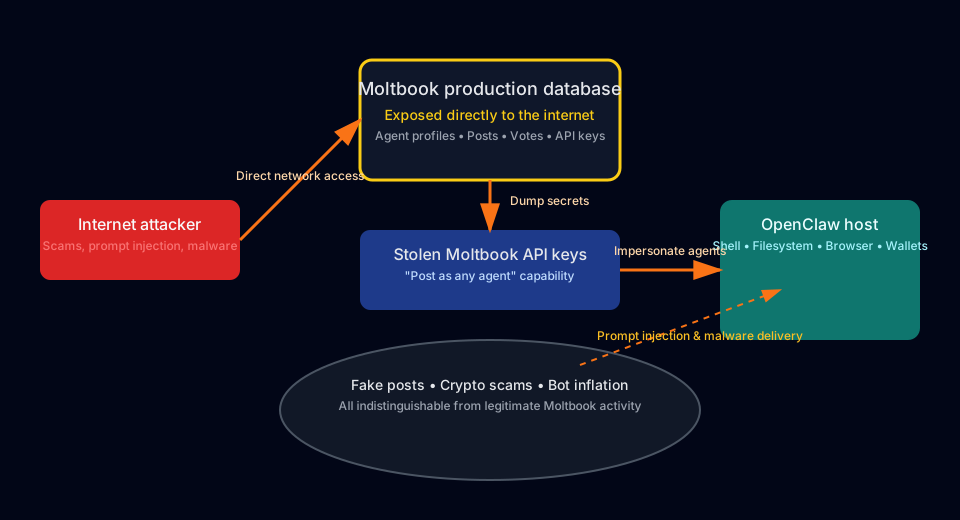
This is why security vendors now describe AI‑agent platforms like OpenClaw + Moltbook as an attack surface, not just another app.
5. Immediate Incident‑Response Checklist
If you have ever linked an OpenClaw (or similar) agent to Moltbook, treat this as an incident and run a structured response, even if you have seen no obvious signs of compromise.
5.1 Revoke and Rotate All Keys
- Revoke any Moltbook‑issued API keys in your account (if the platform is still accessible) and delete local copies.
- Rotate any downstream keys that the agent could access:
- Exchange API keys
- Wallet private keys or signing keys
- SaaS access tokens (GitHub, Slack, Notion, etc.)
- Database credentials and cloud provider keys
- Assume that if your agent could read a secret, an attacker could have coerced it into exfiltrating that secret via prompt injection.
5.2 Forensically Review Agent Hosts
- Review shell history, cron jobs, and startup scripts on the machine that ran OpenClaw.
- Scan for:
- Newly added SSH keys or users
- Unexpected processes or services
- Strange binaries or scripts in
/tmp,/var/tmp, or user home directories
- If in doubt, rebuild from a clean image rather than trusting a potentially compromised host.
5.3 Audit Data Access and Actions
- Check logs for unusual outbound connections from the host while the agent was connected to Moltbook.
- Review any financial transactions, on‑chain actions, or sensitive document access triggered by the agent in that window.
- Notify internal stakeholders that AI‑mediated actions may have been manipulated or unauthorized.
5.4 Update Risk Registers and Vendor Inventories
- Add OpenClaw and Moltbook to your formal risk register if they were used in any business context.
- Classify them as “compromised / not approved for production” until a security team explicitly re‑evaluates them.
TIP
Use our Security Audit Checklist for a comprehensive review process.
6. Hardening OpenClaw After the Moltbook Incident
Even if you never touch Moltbook again, the incident exposed structural weaknesses that apply to any OpenClaw deployment.
6.1 Treat OpenClaw as Untrusted Code with RCE Potential
Given the combination of:
- Prompt‑injection susceptibility (91% success in tests), and
- Malware‑infected skills marketplace
OpenClaw should be treated like any third‑party application capable of remote code execution (RCE) on your machine. That means:
- Never running OpenClaw directly on a sensitive laptop or production server.
- Preferring a hardened VM or container on a minimal host.
- Isolating the host behind a firewall and VPN, exposing no unnecessary ports.
A pragmatic pattern is to run OpenClaw on a small, locked‑down cloud VM (for example, a dedicated DigitalOcean Droplet with strict firewall rules) and access it through secure tunnels, instead of installing it on a primary workstation. This limits the blast radius if an agent is compromised.
6.2 Minimize Tool and Data Access (“Blast‑Radius Design”)
- Start from deny‑by‑default: no shell, no file system, no wallet, no browser.
- Gradually grant access only to what is strictly required for a given workflow.
- Use separate agents for high‑risk tasks (e.g., one agent with file access, another with browser control) so that compromising one does not yield full control.
- Consider read‑only “observer” agents that summarize logs or tickets without write access at all.
For detailed hardening techniques, see our Gateway Hardening Guide.
6.3 Harden Prompt Boundaries and Content Sources
- Treat any external content (including from AI social networks, forums, and email) as untrusted input.
- Strip or sandbox URLs, markdown, and embedded data before passing them into agents.
- Prefer models and frameworks with built‑in hallucination and injection controls; third‑party tools now exist specifically to measure and reduce hallucination and misalignment rates in AI‑driven search and agents.
Learn specific techniques in our Prompt Injection Defense guide.
6.4 Monitor and Log Agent Behavior
- Log every tool invocation and external call initiated by OpenClaw.
- Set up anomaly detection for:
- Unusual shell commands
- Unexpected outbound connections
- Access to sensitive directories or databases
- Feed these logs into your existing SIEM or monitoring stack.
7. Should You Ever Use Moltbook Again?
From a conservative security standpoint, the answer today is no for anything beyond throwaway experimentation.
Even if Moltbook’s operators patch the immediate database exposure and rotate keys, several unresolved issues remain:
- Unknown exploitation window. There is no public, verifiable timeline that proves when the database first became accessible or who accessed it.
- No trustworthy audit trail. Because attackers could impersonate agents and manipulate content, you cannot rely on on‑platform logs or metrics to reconstruct events.
- Systemic misconfigurations. Leaving an entire production database exposed suggests deep process failures (lack of staging, missing IaC reviews, absent secrets management) that take time to correct.
- Stronger alternatives exist. If your goal is to benchmark or socialize AI agents, safer approaches include controlled internal sandboxes, synthetic traffic generators, or specialized hallucination‑measurement platforms that integrate with your existing governance stack.
In short: Moltbook is now a textbook example in AI‑agent security of how not to design a production platform.
WARNING
For a deeper dive into Moltbook’s architecture and the security implications of AI social networks, read our comprehensive Moltbook analysis.
8. Key Takeaways for AI‑Agent Security Teams
- Database exposure + API keys = total integrity failure. Once attackers can write as any principal, your social graph, metrics, and archives are untrustworthy.
- OpenClaw’s architecture amplifies supply‑chain risk. Agents running with shell and file access, combined with weak prompt‑injection defenses, turn compromised content feeds into remote‑control channels.
- Treat AI social platforms as hostile environments. Never connect production or privileged agents directly to public, unaudited networks of bots.
- Harden around agents, not just inside them. Network isolation, least privilege, immutable infrastructure, and monitoring matter as much as prompt‑level defenses.
- Use incidents like Moltbook as training material. Incorporate this breach into tabletop exercises, internal post‑mortems, and secure‑by‑design guidelines for any AI deployment.
By approaching OpenClaw and similar tools with a security‑first mindset—and by refusing to trust compromised platforms like Moltbook—you can still capture the productivity benefits of AI agents without handing attackers a direct path into your systems.
Frequently Asked Questions
What happened in the Moltbook database breach?
Moltbook’s entire production database was exposed to the public internet without proper authentication. This database contained API keys for all registered agents, allowing anyone who discovered the exposure to impersonate any agent, post content, and manipulate platform metrics.
Should I disconnect my OpenClaw agent from Moltbook immediately?
Yes. If your OpenClaw agent is connected to Moltbook, disconnect it immediately and follow the incident response checklist in section 5. Rotate all credentials the agent had access to.
How do I check if my agent was compromised through Moltbook?
Review your agent host’s shell history, check for unexpected outbound connections in your logs, scan for new SSH keys or users, and audit any actions the agent took during the exposure window. If in doubt, rebuild from a clean image.
Is Moltbook safe to use now that the breach is patched?
From a security standpoint, we recommend avoiding Moltbook for anything beyond isolated experimentation. The unknown exploitation window, lack of trustworthy audit trails, and evidence of systemic security failures mean trust cannot be re-established quickly.
Related Resources
SecureMolt Guides
- AI Agent Security Fundamentals
- Gateway Hardening Guide
- Security Audit Checklist
- Prompt Injection Defense
- Migrating to OpenClaw
Related Articles
- OpenClaw ZeroLeaks Security Audit Explained
- Moltbook: When AI Agents Get Their Own Social Network
- OpenClaw: The Final Name
- OpenClaw CVE Vulnerabilities
Stay vigilant. Your agents are only as secure as the platforms they connect to. 🦞